Choosing the right karaoke software can shape the entire guest experience in your venue. The platform you choose affects song availability, audio quality, ease of use, scalability, licensing confidence, and even how long customers stay and spend in your venue.
The karaoke software market has grown significantly in recent years, with the global karaoke market valued at $5.4 billion in 2023 and projected to reach $9.31 billion by 2033. That growth means more options for venue operators — and more decisions to get right.
For karaoke bars, private karaoke rooms, entertainment centers, hotels, pubs, bowling alleys, and franchise concepts, the software decision goes beyond simply playing songs. The right platform should support smooth operations, modern customer expectations, and long-term business growth.
This guide compares the six most talked-about platforms for business use: Singa, KaraFun, Lucky Voice, Stingray Karaoke, Party Tyme Karaoke, and PCDJ Karaoki. It covers song libraries, licensing, usability, pricing, and what each platform actually does well.
Table of contents:
- What to look for in karaoke software for your venue
- Singa
- KaraFun
- Lucky Voice
- Stingray Karaoke
- Party Tyme Karaoke
- PCDJ Karaoki
- Karaoke software comparison table
- Which karaoke software is best for different business types?
What to look for in karaoke software for your venue
Before diving into individual platforms, it helps to know the criteria that matter most for commercial use:
1. Catalog size and variety
A library of at least 75,000 well-updated songs ensures you can serve different age groups, musical tastes, and language preferences.
2. Commercial licensing
Using unlicensed software in a public venue is a legal liability; the platform you choose must explicitly cover commercial performance. Platforms that source music directly from labels and publishers can offer more consistency and professional-grade experiences.
3. Mobile song requests
Guests expect to browse and queue songs from their phones; this reduces crowding at the host station and increases dwell time.
4. Self-service functionality and ease of use
Modern guests expect to browse songs, join the queue, and manage their experience without flagging down staff — and intuitive, app-like interfaces make that possible. The easier the software is to navigate, the less pressure on your team and the better the experience for everyone, especially on busy nights.
5. Queue management
Singer rotation, history tracking, and session management are table-stakes features for hosted karaoke.
6. Centralized management for karaoke rooms
Room-based venues operate differently than open-floor KJ nights. Look for: self-service guest controls, stable tablet interfaces, fast song search, reliable streaming, and centralized room oversight from a single dashboard.
7. Hardware flexibility
Some venues want all-in-one managed solutions, while others prefer software that works with existing TVs, tablets, microphones, and sound systems. Compatibility across devices and operating systems can significantly reduce setup costs.
8. Scalability for chains and franchises
Single-location venues and large entertainment brands often have very different operational needs. Enterprise-ready karaoke software typically offer centralized management tools, multi-venue administration, branding capabilities, analytics, account management, and dedicated account support.
9. Offline capability
Venue Wi-Fi is notoriously unreliable; your software should function without a live internet connection.

The platforms at a glance
Singa: Built for modern karaoke venues and scalable brands
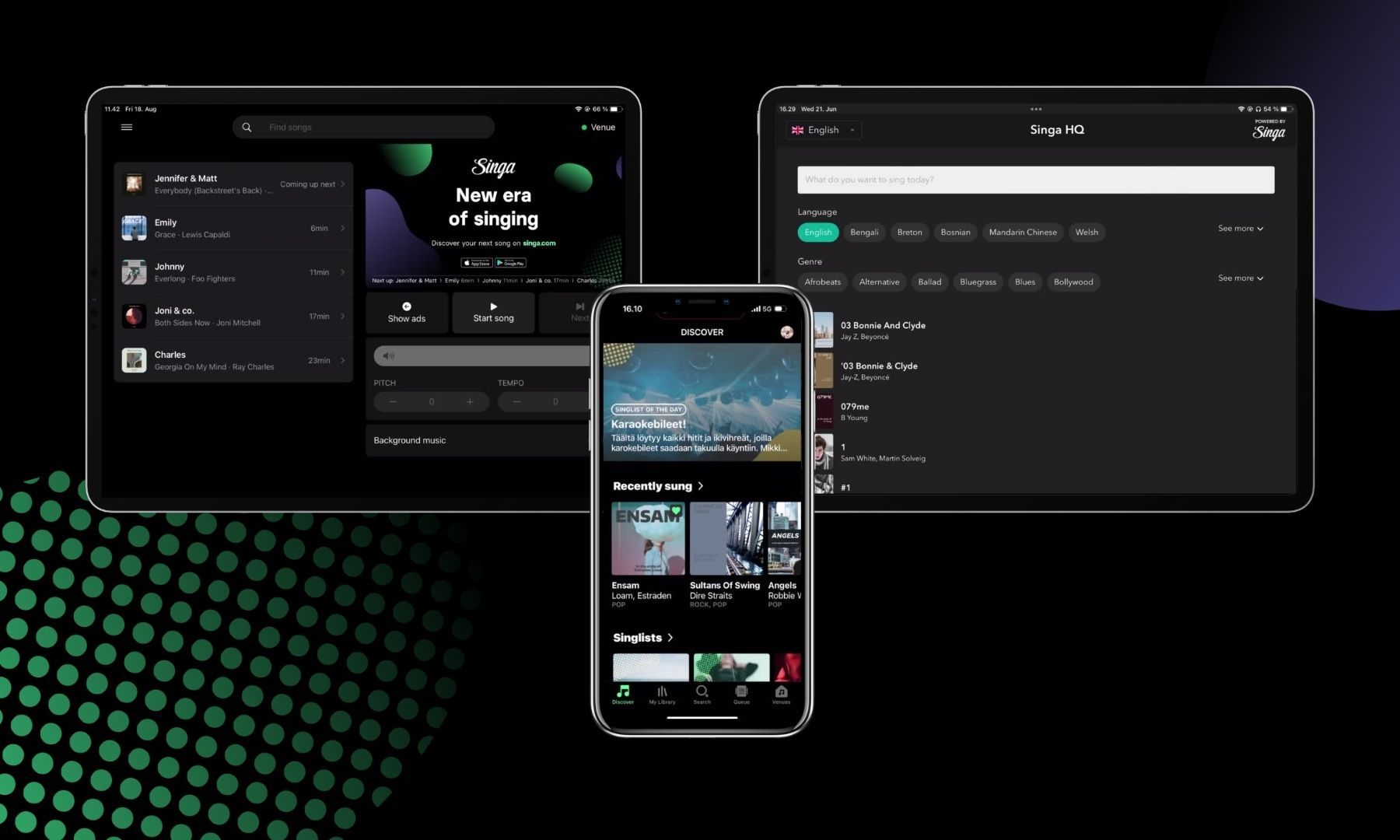
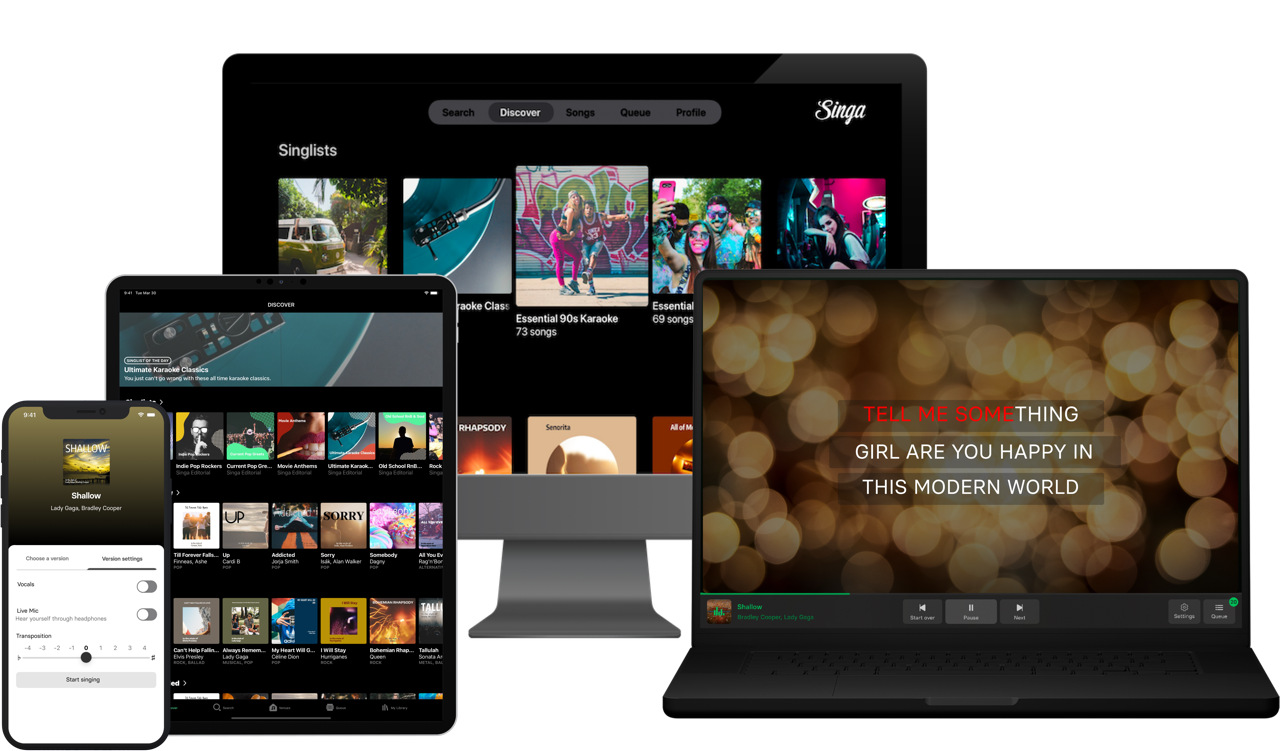
Singa is a cloud-based karaoke platform built specifically for commercial venues. The platform runs on iPad and integrates directly with the Singa consumer app, so guests can browse and request songs from their own phones.
Singa holds the largest overall song catalog – currently standing at 140,000+ songs – among business-focused providers, backed by direct partnerships with major labels including Warner Music Group. That means access to original master recordings rather than the re-recorded versions that fill many competing catalogs, providing meaningful difference in audio quality and song authenticity. With coverage spanning over 40 languages, it also leads the field for multilingual venues.
Singa also integrates with Soundtrack Your Brand for licensed background music between sessions, and supports on-screen advertising for additional venue revenue.
Where Singa separates itself most clearly from the competition is in its enterprise offering. The Singa Enterprise package includes API access for integrating with booking systems, CRMs, and POS platforms; advanced analytics covering occupancy rates, usage patterns, and industry benchmarks; and a dedicated Customer Success Manager. These are tools that matter when you're running multiple rooms or multiple venues and need operational visibility, not just a song player.
Best for: Karaoke room venues, hospitality groups, entertainment franchises, and multi-location operators.
- ✅ Largest licensed song catalogue
- ✅ Original master recordings
- ✅ 40+ languages
- ✅ Mobile app
- ✅ Enterprise ready
- ✅ Centralized room management
- ✅ Advertising features
- ✅ Dedicated customer support
- ✅ Advanced analytics
- ✅ Background music
- ✅ Singa booking system
- ✅ Custom branding
KaraFun: Flexible and accessible for smaller operators
KaraFun Business is aimed at venue operators running fixed karaoke installations — karaoke boxes, bars, and entertainment spaces. It uses a per-device subscription model ($199 USD/month per room) and the catalog covers 55,000+ songs in HD audio and video, spanning 30+ genres and multiple languages, with around 400 new tracks added monthly. Guest-facing features include phone-based song requests via QR code, a competitive "Battle" singing mode, music quizzes, and a real-time selfie display.
Where KaraFun shows limitations is in its enterprise-level toolset. Multi-venue analytics, API integrations, and the kind of centralised management expected by larger operators are not a core part of its offering. It's a strong product for single-venue operators, bars hosting regular karaoke nights, and KJs who want a well-stocked, professionally maintained library. French-language content is a particular strength, given KaraFun's European roots.
Best for: Single-location bars and venues, KJs, operators looking for a straightforward subscription model.
Singa vs KaraFun
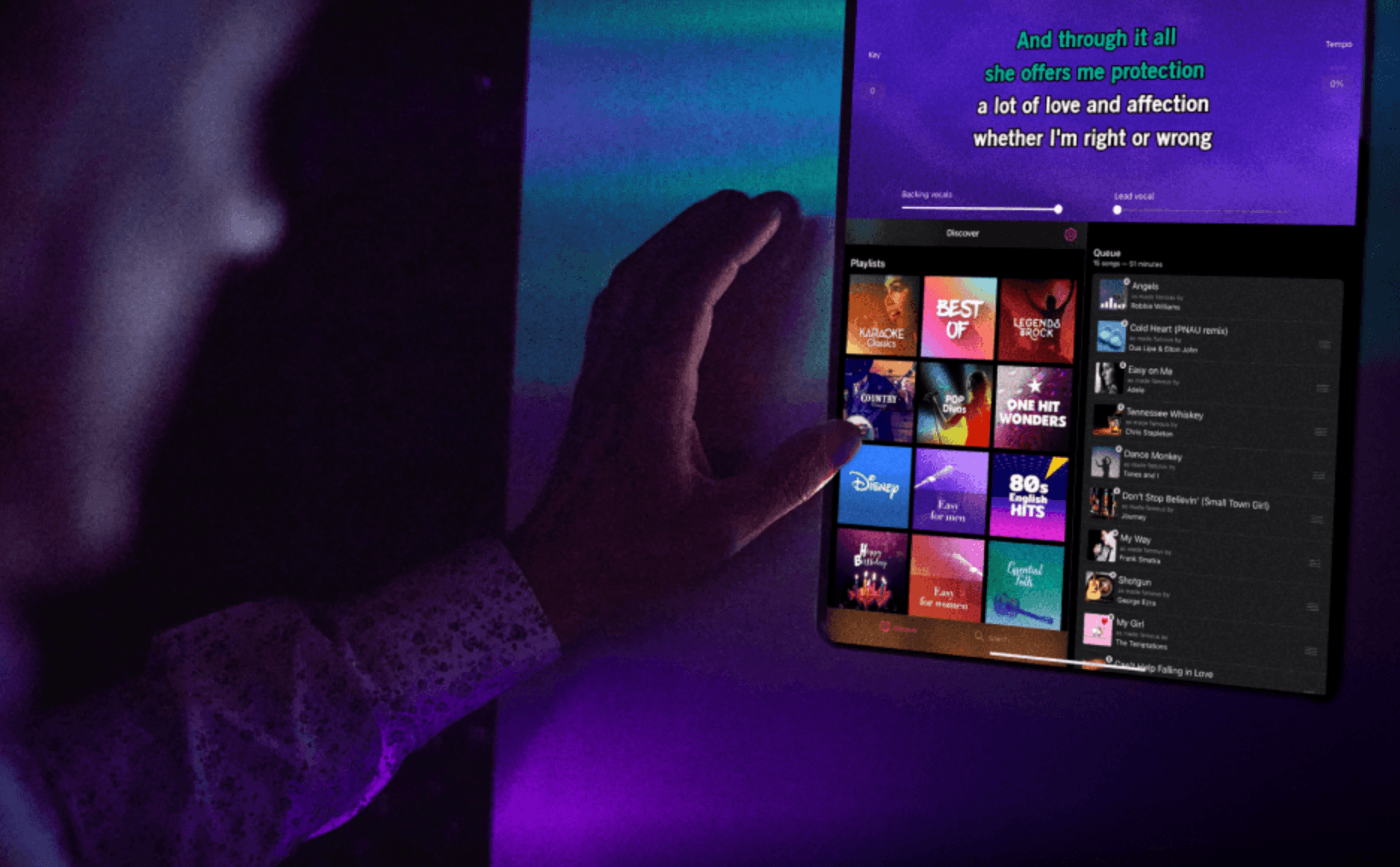
KaraFun Business and Singa overlap most at the single-venue level, where both support self-service rooms and phone-based song requests. The gap widens as operations grow: Singa offers multi-venue management, API integrations, and advanced analytics that KaraFun Business does not. Catalog quality is also a differentiator — Singa's original master recordings versus KaraFun's re-recorded versions is a noticeable difference at the premium end of the market.
KaraFun is often favored by smaller bars, independent venues, and operators looking for a straightforward karaoke solution with offline playback capabilities.
Singa focuses more heavily on commercial entertainment venues, karaoke rooms, and multi-location businesses. Mobile song queueing, room-friendly user experiences, and enterprise management capabilities make it particularly attractive for venues that want customers to control their own karaoke experience.
Choose KaraFun if:- You operate a small independent venue
- You primarily need basic karaoke functionality
- You run private karaoke rooms
- You operate multiple locations
- You want mobile-first customer experiences
- You need enterprise-level support and scalability
Lucky Voice: Strong karaoke room heritage
Lucky Voice for Business is widely associated with private karaoke room culture, especially in the UK market. Backed by 20+ years of experience running their own karaoke bars in London and Brighton, Lucky Voice comes with dedicated venue management (the Venue Manager system), hardware bundles (including the Singstation, a professional mixer with integrated software), and an account manager for ongoing support.
The Windows-based platform covers thousands of songs — the catalog is not publicly specified at a firm number, with venue setups citing 9,000 to 13,000+ tracks depending on the package, which is notably smaller than competitors. The platform is particularly strong for UK and Ireland venues, with partners including Tenpin, Firmdale Hotels, and Big Fang Collective.
The interface is customizable with venue branding, and Lucky Voice offers hardware solutions alongside the software for operators starting from scratch. Its UK-based support team and dedicated account managers are frequently highlighted by venue partners as a genuine strength.
The platform does have some clear constraints. It does not currently integrate with external booking systems, which can create friction for venues that rely on online reservations. It is also primarily built for the UK and Irish market, and international support options are more limited. The software is also not cloud-native, meaning cross-venue management and advanced analytics are outside its scope.
Best for: UK bars, pubs, hotels, and leisure venues wanting a reliable, locally-installed solution.
Singa vs Lucky Voice
Lucky Voice and Singa are both built for venue operators rather than KJs. However, Singa's international footprint and enterprise offering may appeal more to operators planning expansion across multiple locations or markets.
Lucky Voice's strength is its local installation reliability and its deep familiarity with UK hospitality. Singa's strength is everything that happens beyond the single venue: cloud-based management, booking system integrations, cross-location analytics, and a catalog built on original recordings.
For operators based in the UK running one or two venues with no immediate plans to expand, Lucky Voice is a credible option. For those building toward scale, or operating outside the UK, Singa covers ground that Lucky Voice currently does not.
Choose Lucky Voice if:- You're operating within the UK market where the brand already has strong consumer recognition
- You want a karaoke-room-focused solution
- You need scalable multi-location management
- You want direct music licensing partnerships
- You plan to expand your entertainment concept over time
Stingray Karaoke: Extensive content ecosystem
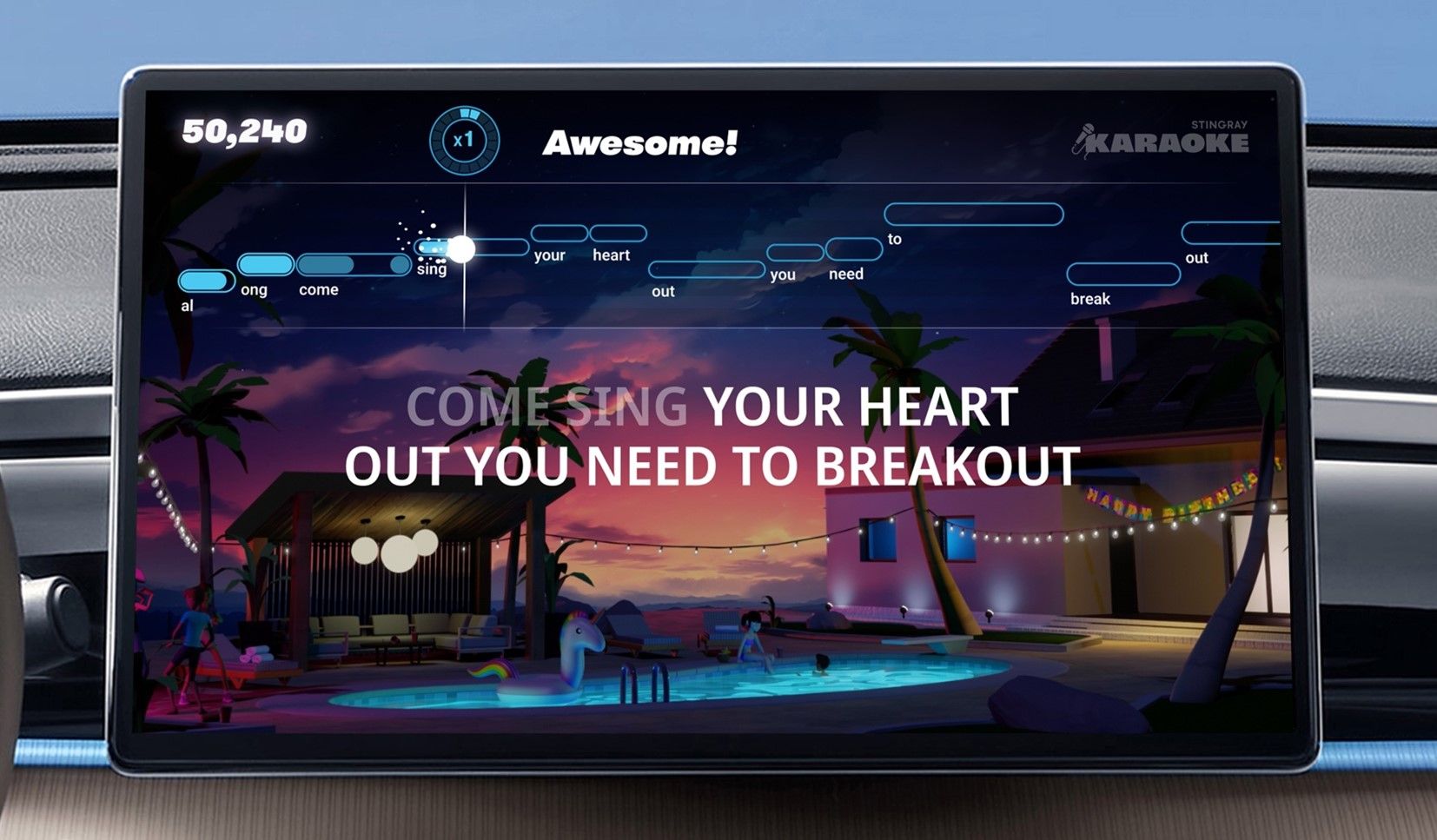
Stingray is a large Canadian media and technology company with a catalog of over 100,000 karaoke songs. Its karaoke product has gained significant attention for integrations with Samsung TVs, Ford vehicles, Tesla, BYD, and most recently, Mercedes-Benz. Those partnerships reflect where Stingray's karaoke focus sits: consumer electronics and automotive infotainment, rather than venue management.
Stingray does have a business division covering background music and in-store audio, but its karaoke software is not purpose-built for commercial karaoke room operations. Venue-specific features like room management, multi-location analytics, booking integrations, and branded guest interfaces are not part of its karaoke product. For entertainment venue operators, Stingray is worth knowing about, but it is not currently competing in the same space as Singa or KaraFun Business.
Best for: Consumer electronics integrations, background music in retail, in-car entertainment.
Singa vs Stingray Karaoke
These two products are not meaningfully competing with each other. Stingray Karaoke is a consumer app distributed through smart TVs and vehicle infotainment systems. Singa is a venue management platform. The only reason to put them side by side is catalog size — Stingray's 100,000+ tracks is a large number — but a large catalog built for solo home use is a different thing from a managed, licensed, venue-ready library with original recordings and commercial support behind it.
Stingray Karaoke benefits from its broader music ecosystem and extensive multilingual content.
Singa differentiates itself through its venue-focused experience, mobile usability, and tools designed specifically for karaoke businesses.
Choose Stingray if:- Karaoke is an additional attraction rather than the centerpiece of your venue
- You don't need specialized tools for karaoke room operations
- Karaoke is a core part of your business
- Customer self-service is important
- You need tools built specifically for karaoke rooms and venues
Party Tyme Karaoke: Traditional karaoke hosting focus
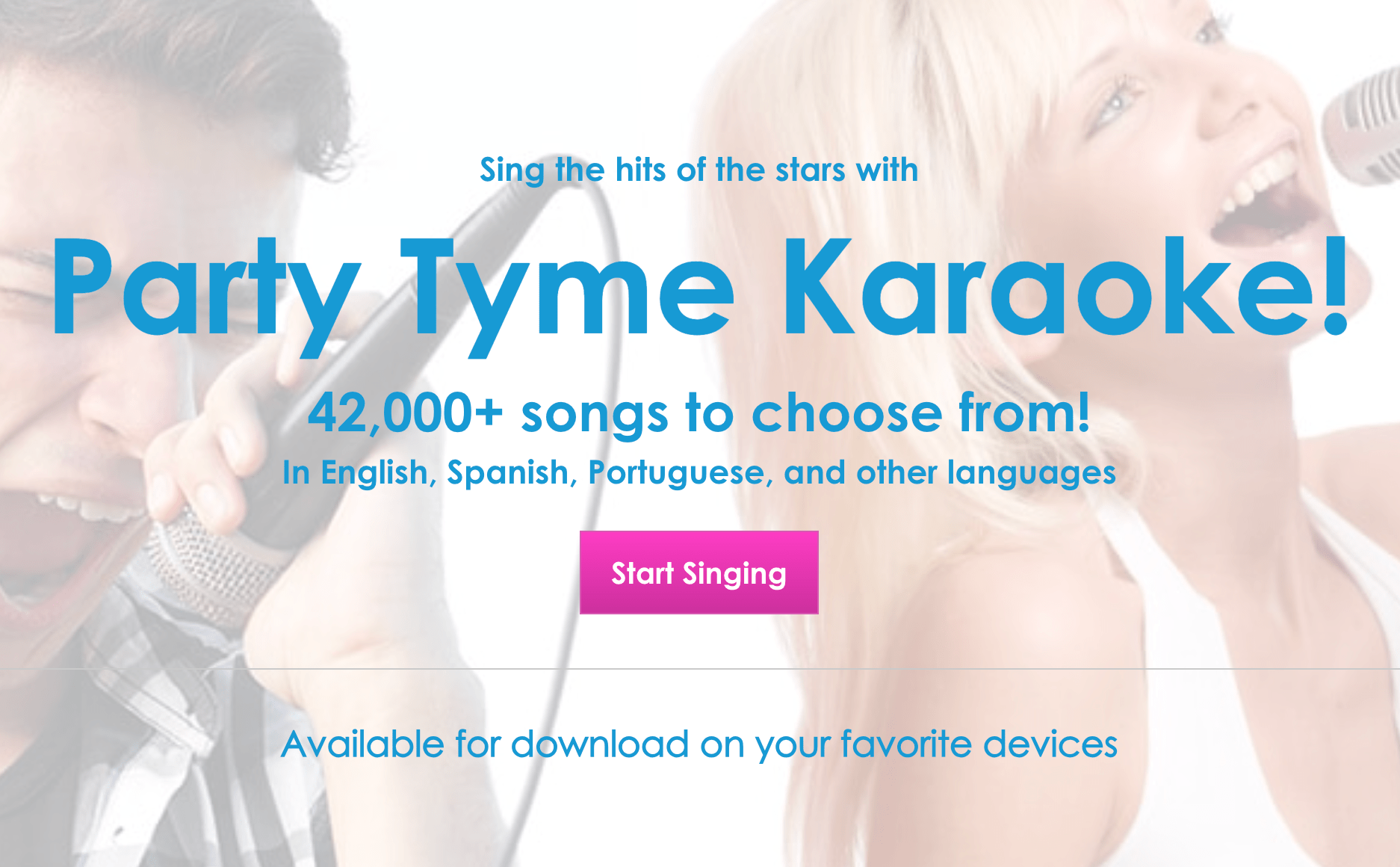
Party Tyme is a commercially licensed karaoke subscription service with 44,000+ songs, available through PCDJ's DEX 4 and LYRX software. The subscription runs at $49.99/month (or $499.99/year), includes a 7-day free trial, and allows the full catalog to be downloaded for offline use. Licensing covers commercial performance (though ASCAP/BMI/SESAC fees remain the venue's responsibility).
Party Tyme is a content library, not a standalone software platform. To use it, you need PCDJ's software, which is a separate purchase. The combination works well for KJs and DJs who already run PCDJ, but it adds a layer of cost and complexity for venue operators looking for a single, self-contained solution.
Best for: KJs supplementing their existing PCDJ setup with a licensed streaming library.
Singa vs Party Tyme Karaoke
Party Tyme is a content subscription bolted onto a KJ software stack. Singa is an end-to-end venue platform with its own catalog, guest interface, room management, and reporting. The catalog difference is significant — around 44,000 tracks versus Singa's multilingual library sourced from original recordings. For a venue operator evaluating these side by side, Party Tyme is not a like-for-like alternative; it is a component of a KJ setup, not a replacement for a venue platform.
Choose Party Tyme if:- KJ workflows are your priority
- You operate karaoke rooms or a karaoke venue
- You want customers to browse and queue songs independently
- You need a modern venue experience
PCDJ Karaoki: Built for professional karaoke hosts
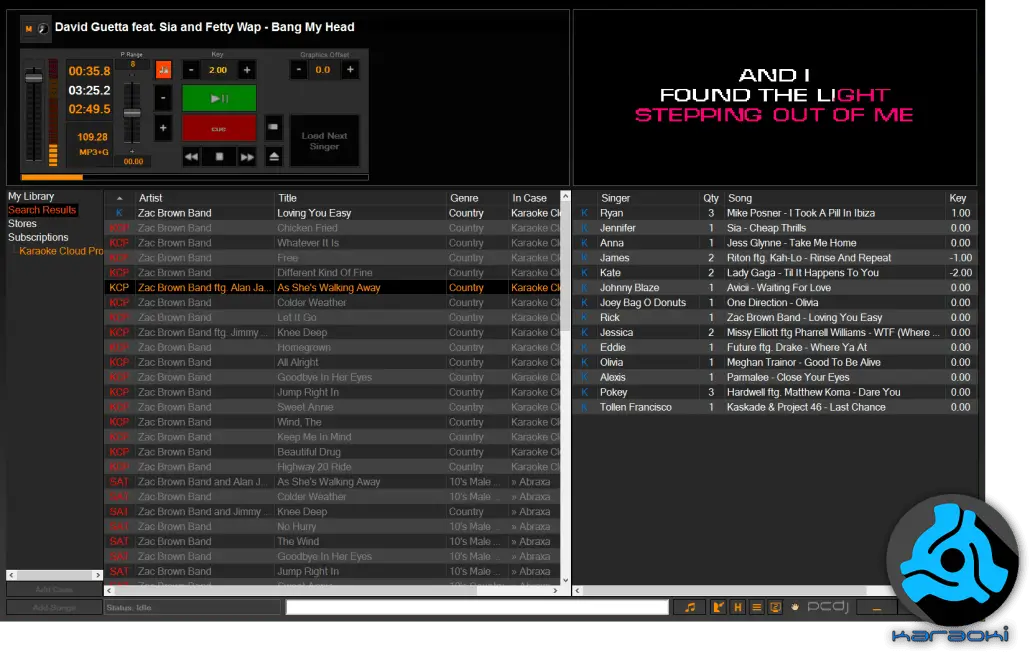
PCDJ Karaoki is professional Windows-based software designed for karaoke jockeys. At a one-time cost of $99, it offers advanced singer rotation management, singer history tracking, key control, a background music filler player, and integration with remote request systems like SongBookDB. It handles a wide range of file formats including MP3+G, WAV+G, and video files.
The important caveat: PCDJ Karaoki does not include a song library. You either bring your own files or subscribe separately to a service like PartyTyme Karaoke to access tracks. That model suits KJs who have built their own libraries over years of gigging. For a venue operator who wants a managed, always-current catalog without the overhead of file management, it adds a layer of complexity that cloud-based platforms avoid entirely.
Best for: Professional KJs, mobile entertainers, hosts managing their own song libraries.
Singa vs PCDJ Karaoki
PCDJ Karaoki and Singa serve different operators entirely. PCDJ is built around a single host managing a show from their own machine, with no song library included. Singa is built around a venue running multiple rooms, often without a host in the room at all. If you are a KJ, PCDJ offers more granular playback and rotation control than Singa is designed to provide. If you are a venue operator, PCDJ requires you to source and manage your own music library, which adds overhead that a cloud platform eliminates.
Choose PCDJ Karaoki if:- You are a professional KJ
- Advanced hosting controls are your priority
- You prefer managing local karaoke libraries
- You want a turnkey commercial solution
- You run karaoke rooms or entertainment venues
- You need centralized management across locations
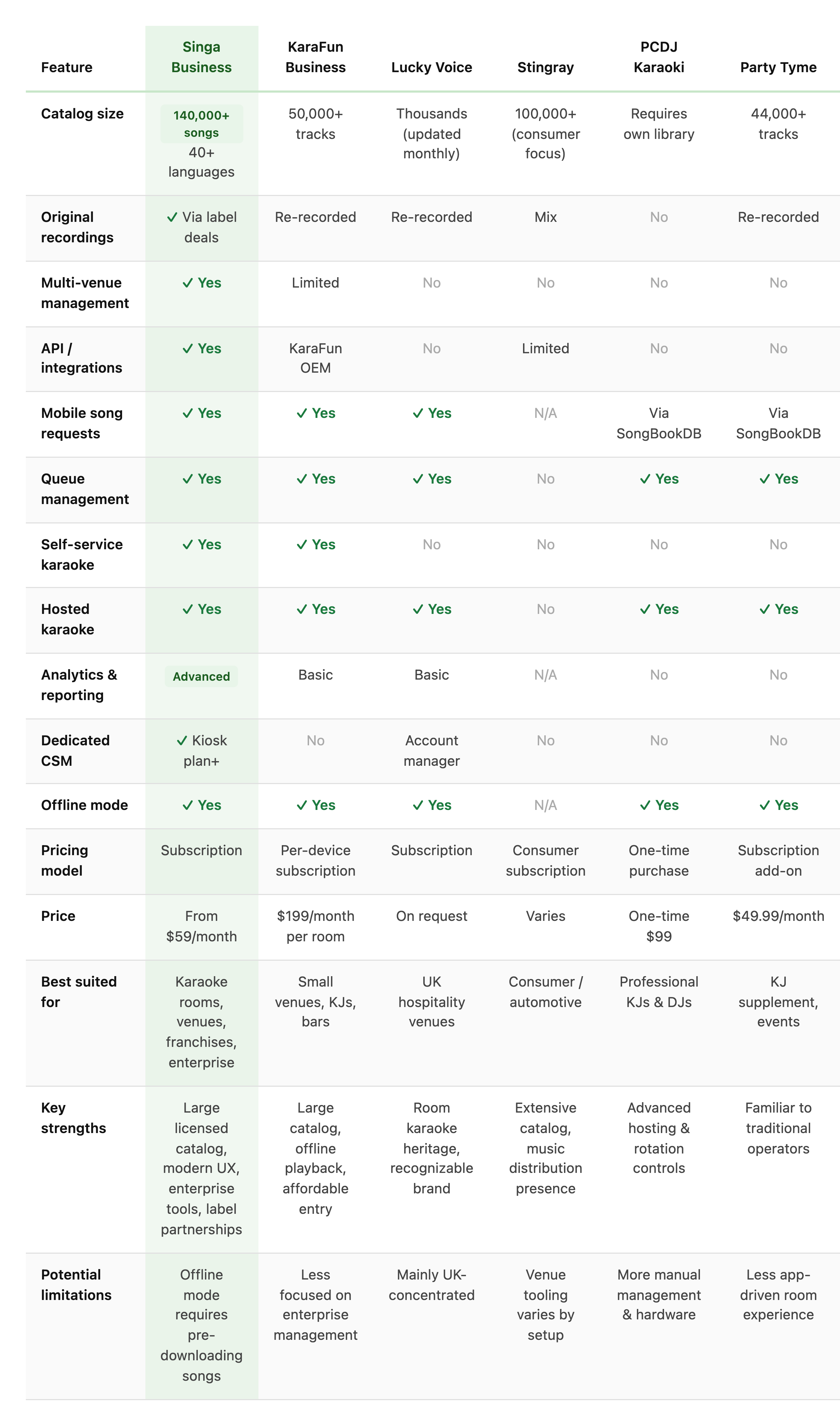
Karaoke software comparison table
| Feature | Singa Business | KaraFun Business | Lucky Voice | Stingray | PCDJ Karaoki | Party Tyme |
|---|---|---|---|---|---|---|
| Catalog size | Largest (140,000+ songs; 40+ languages) | 50,000+ tracks | Thousands (updated monthly) | 100,000+ (consumer focus) | Requires own library | 44,000+ tracks |
| Original recordings | Yes (via label deals) | Re-recorded versions | Re-recorded versions | Mix | No | Re-recorded versions |
| Multi-venue management | Yes | Limited | No | No | No | No |
| API / integrations | Yes | KaraFun OEM | No | Limited | No | No |
| Mobile song requests | Yes | Yes | Yes | N/A | Via SongBookDB | Via SongBookDB |
| Queue management | Yes | Yes | Yes | No | Yes | Yes |
| Self-service karaoke | Yes | Yes | No | No | No | No |
| Hosted karaoke | Yes | Yes | Yes | No | Yes | Yes |
| Analytics & reporting | Advanced | Basic | Basic | N/A | No | No |
| Dedicated CSM | Yes (for Kiosk and above) | No | Yes (Account Manager) | No | No | No |
| Offline mode | Yes | Yes | Yes | N/A | Yes | Yes |
| Pricing model | Subscription | Per-device subscription | Subscription | Consumer subscription | One-time $99 | Subscription add-on |
| Price | Starts from $59/month | $199 month per room | Available on request | Varies | One time $99 | $49.99/month |
| Best suited for | Karaoke rooms, entertainment venues, franchises, enterprise | Small venues, KJs, bars | UK hospitality venues | Consumer / automotive, commercial entertainment | Professional KJs and DJs | KJ supplement, events, mobile entertainment |
| Key strengths | Large licensed catalog, modern UX, enterprise tools, direct label partnerships, scalable multi-room support | Large catalog, offline playback, affordable entry point | Strong room karaoke heritage, recognizable brand | Extensive catalog and established music distribution presence | Advanced hosting controls and singer rotation tools | Familiar to traditional karaoke operators |
| Potential limitations | As cloud-based software, offline mode required some preparation beforehand (downloading songs). | Less focused on enterprise venue management | More regionally concentrated (UK) | Interface and venue tooling may vary by setup | Requires more manual management and hardware involvement | Less focused on app-driven room experiences |
Which karaoke software is best for different business types?
The best karaoke software depends heavily on your venue type, operational model, and growth plans.
Best for karaoke rooms and franchise brands: Singa
Businesses focused on:
- Premium karaoke rooms
- Modern customer UX
- Multi-location growth
- Brand consistency
- Scalable operations
…will likely benefit most from Singa’s business-focused ecosystem.
Its combination of licensed music sourcing, mobile-first usability, and enterprise support makes it particularly strong for operators building long-term entertainment concepts.
Best for smaller independent venues: KaraFun, Singa
Smaller bars and casual karaoke operators will appreciate how KaraFun and Singa are built around simplicity, easy setup, and flexible options.
Best for hosted karaoke nights (KJs): PCDJ Karaoki or PartyTyme
Traditional karaoke hosts and KJs often prioritize rotation management, local libraries, and manual control. PCDJ Karaoki and PartyTyme fit these workflows well.
If your venue runs karaoke in-house without hiring an external KJ, we'd recommend Singa or KaraFun instead.
Best for UK hospitality karaoke experiences: Lucky Voice
Lucky Voice remains strongly associated with social karaoke room experiences, particularly in markets where its brand already has strong consumer recognition.
Thinking about software for your karaoke venue? Talk to the Singa team to find the right setup for your operation.