For years, karaoke demand was treated as a fixed pie. The assumption was simple: people want the classics, the evergreen crowd-pleasers, and the songs everyone already knows. Add more songs and singers may choose differently, but overall demand stays the same.
Music itself moved on from that idea long ago. Spotify’s Culture Next research shows Gen Z listeners are significantly more likely than older generations to explore niche genres, non-English music and emerging artists. The IFPI Global Music Report reports the same thing at industry scale: more artists being discovered, fewer songs dominating global charts, and listening fragmenting into more local, more personal choices year on year. As we covered in Singer habits are changing fast, people do not just want the hits anymore. They want their hits.
Singa's usage data across Finland, the United Kingdom and the United States now shows that same shift inside karaoke. Bigger, deeper catalogs do not simply redistribute existing demand — they create new singing. And when original artist recordings are added through Singa Originals, both the total volume and the shape of what people choose to sing change at the same time.
People are not only choosing different songs. They are finding more reasons to sing.
How deep do users actually sing?
The first thing the data destroys is the "everyone just sings the hits" assumption. Across all three markets, only 20–33% of plays go to the top 100 songs, and 41–53% of plays come from songs outside the top 500. That is the long tail doing real work, not a rounding error.
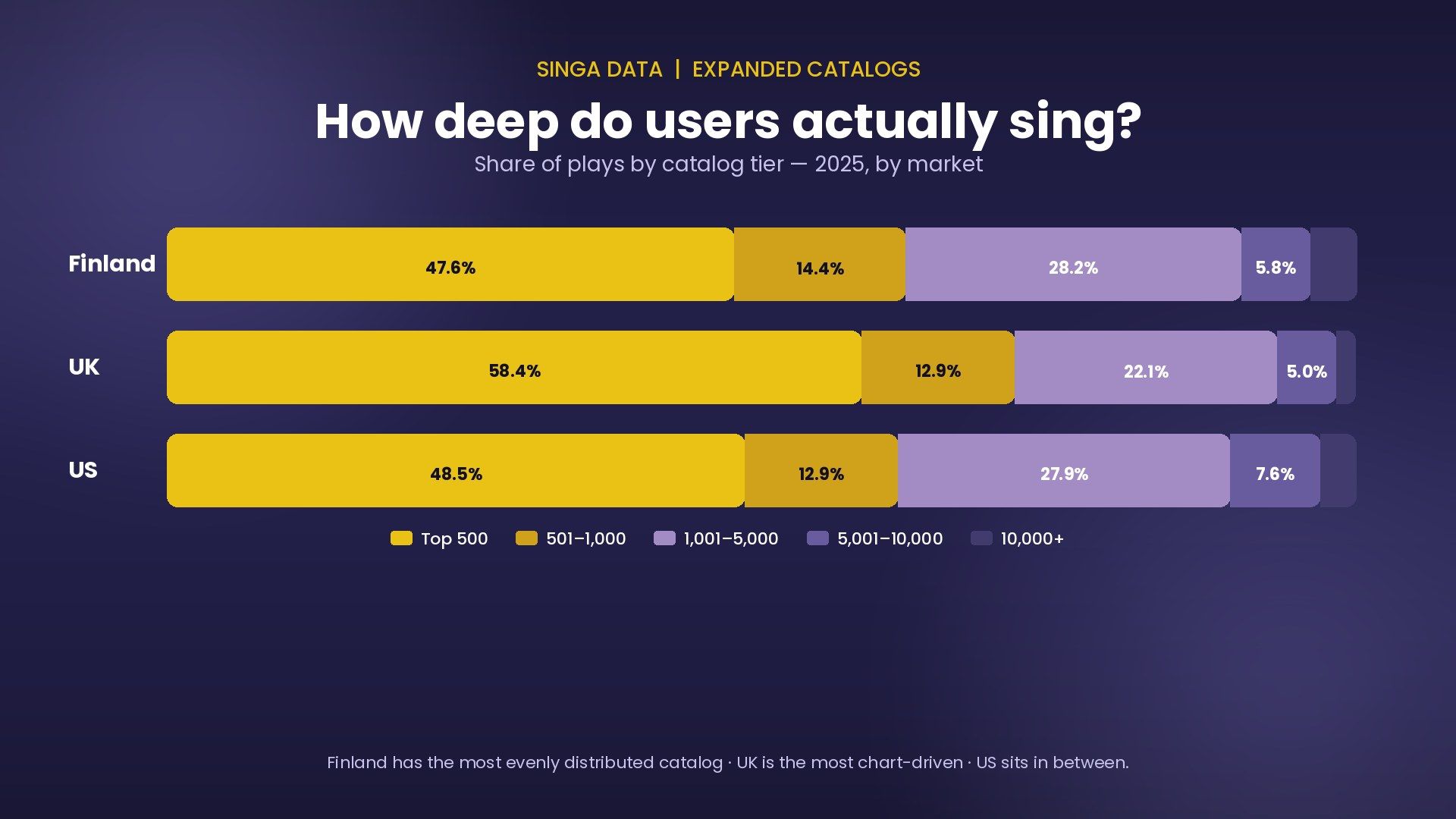
The market profiles look different in revealing ways. Finland is the most evenly distributed market: the top 500 captures only 47.6% of plays, leaving more than half of all singing in the long tail. The UK is the most chart-driven, with the top 500 alone responsible for 58.4%. The US sits in between at 48.5% — closer to Finland than to the UK. Local-language repertoire and niche genres pull Finnish listeners deeper into the catalog; the UK market remains anchored by a strong evergreen core of pub-singalong anthems.
The second 500 songs are nearly as valuable as the first
Songs ranked 501–1,000 consistently account for 13–15% of all plays across every market and every year. The second 500 songs are nearly as valuable as the first 500 — and they get a fraction of the attention. Many platforms' entire back-catalogs are smaller than this single band.
Deeper still, the 4,000 songs ranked between 1,001 and 5,000 collectively drive roughly 1 in 4 plays (25–30% across markets). This is the working catalog — neither top hits nor deep obscurities. It is the engine of sustained engagement, and it scales linearly with how much of the catalog you actually ship.
A catalog that stops at 5,000 songs leaves measurable play volume on the table — every single week.
The deep long tail is the fastest-growing segment
The clearest year-over-year signal in the data is at the very bottom of the catalog. Songs ranked below 10,000 — the deep long tail — more than doubled their share of plays in Finland in a single year (1.6% → 3.9%, 2024 → 2025). The US grew 70% (1.8% → 3.0%) and the UK grew 60% (1.0% → 1.6%) over the same period.
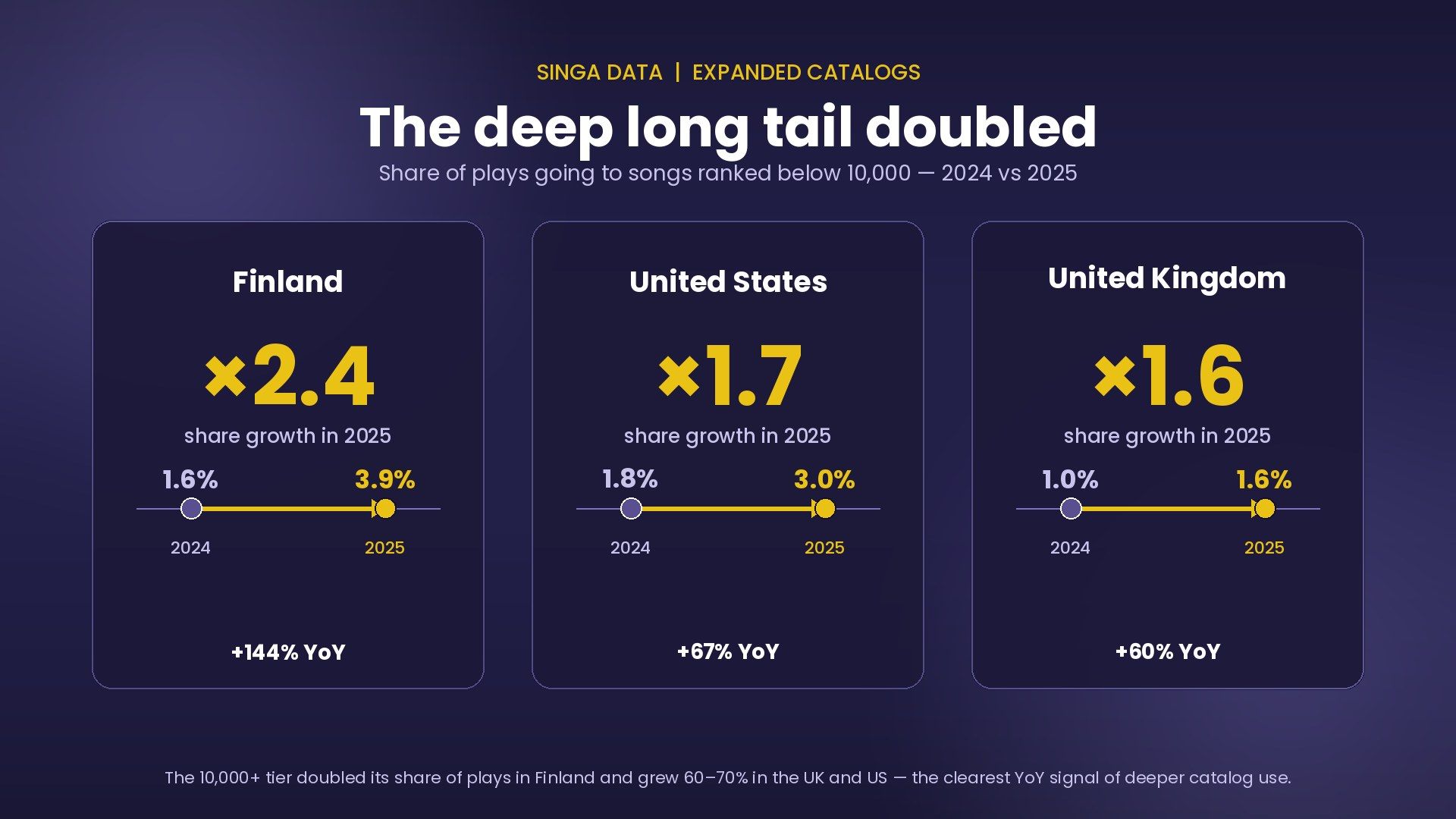
These are tiny segments in absolute terms — the top 10,000 songs still capture 95–97% of plays — but the remaining 3–5% is growing, not shrinking. That is the structural fingerprint of a market where users are actively spreading out as the catalog deepens.
The biggest songs still mattered, but deeper catalog choices were responsible for nearly half of the added usage. The overall pie was getting bigger.
From near-zero to one in six songs sung
The deeper catalog story runs alongside an even more striking shift: the arrival of Singa Originals, the official artist recordings now available to sing in karaoke for the first time. The adoption curve is unusual to look at.
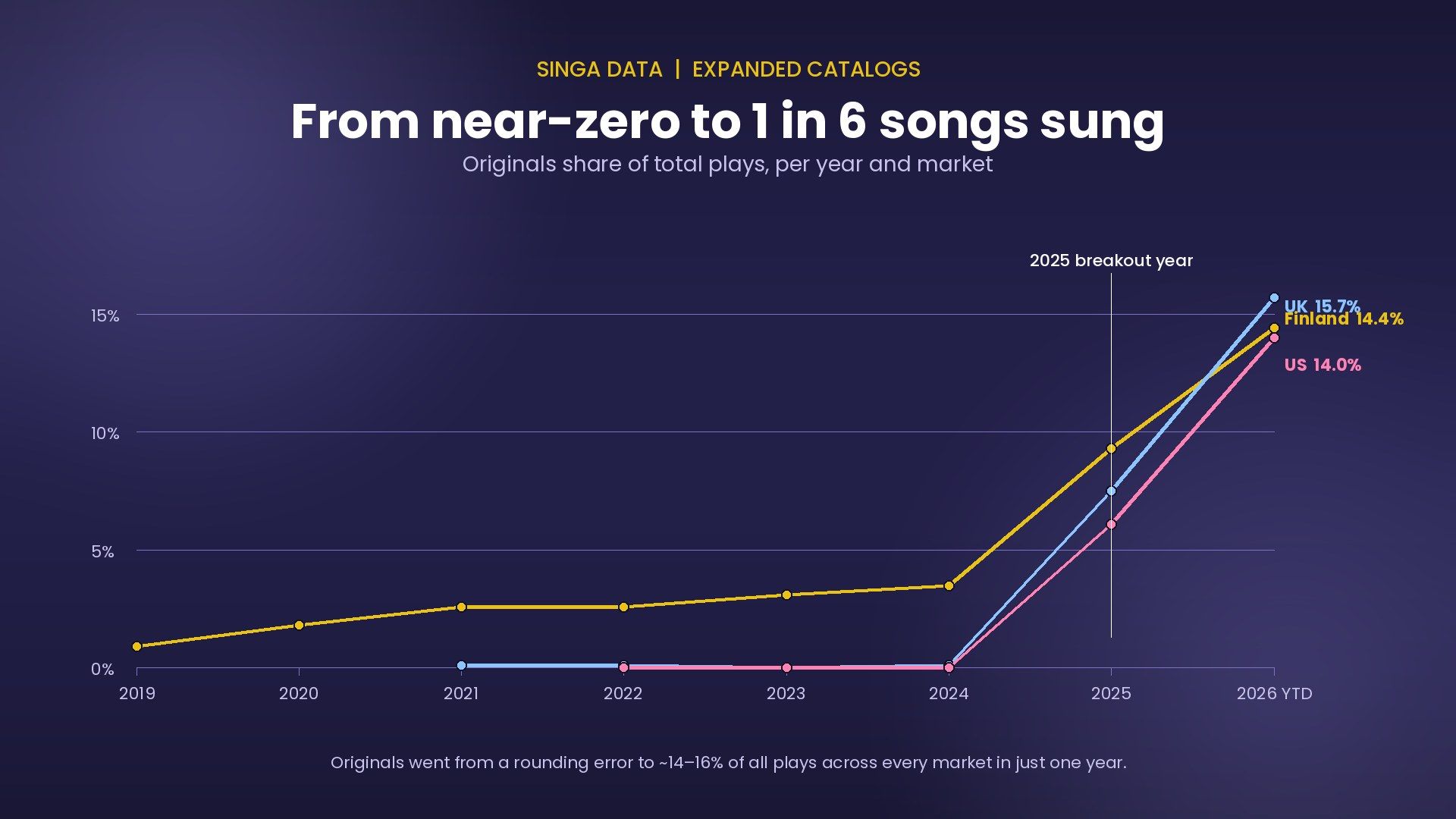
In Finland, originals went from less than 1% of plays in 2019 to 9.3% in 2025, and then 14.4% in the first half of 2026 alone. The UK and US barely registered before 2025, then exploded: UK originals hit 7.5% in 2025 and 15.7% in 2026 YTD. The US matched: 0.0% → 6.1% → 14.0%. Every market roughly doubled its originals share in the first half of 2026 alone.
That is the fingerprint of a category transformation — not a feature ramp. As covered on the Singa Originals post, this is karaoke moving from the soundalike era into something that feels much closer to how people already experience music elsewhere.
The supply side has scaled to match. Singa now produces more original songs in more languages than any other karaoke provider — thousands of new tracks every month, with a goal of 10,000+ new songs produced monthly by mid-2026. Deals with the major labels alongside Believe and Merlin mean singers are not just getting the global top 40. They are getting full artist catalogs, indie releases, and the local-language repertoire that traditional karaoke libraries never carried.
When both exist, users pick the original
The most revealing test is what happens when a song exists in both formats — original recording and karaoke backing track. Which one do users actually choose? Looking at UK songs with both versions available, the answer is clear: users pick the original about 65% of the time on average, and on emotionally-loaded songs the preference is overwhelming.
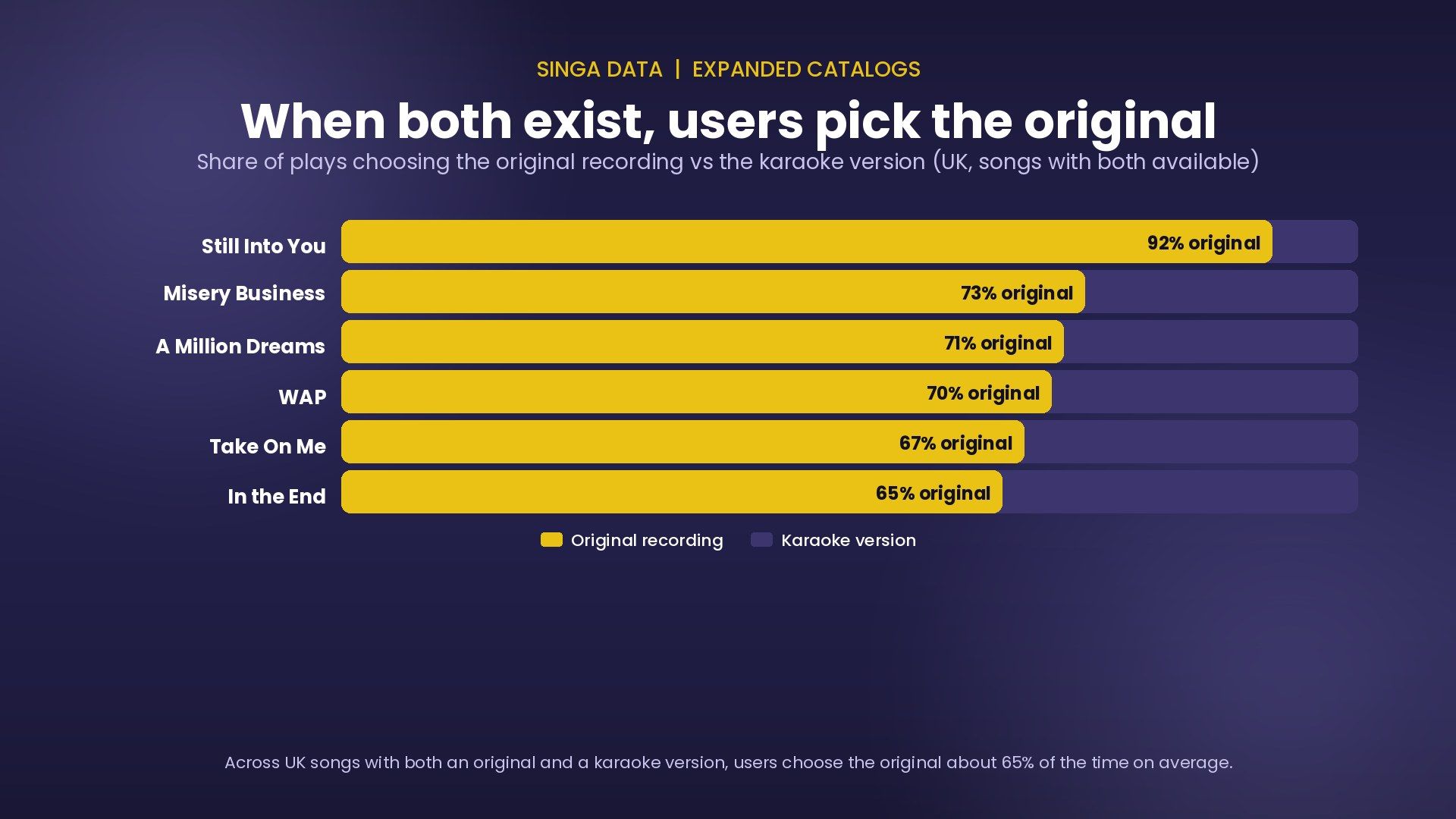
Still Into You is sung as the original 92% of the time. Misery Business, A Million Dreams, WAP, Take On Me and In the End all cluster between 65% and 73%. These are songs where users want to perform with the artist — the recording is part of what they're paying tribute to.
When both formats exist, users overwhelmingly choose the original.
The same effect shows up in the charts themselves. When WAP was released, it became the #1 karaoke song in the US, Australia and the UK for several months — an outcome that would have been unthinkable in the old karaoke model. More recently, Lose Control by Teddy Swims hit #1 in the US after being released as an original, outperforming long-time staples almost overnight. In the UK, Fairytale of New York surpassed Last Christmas for the first time in Singa history after being released as an original. And Take On Me became the UK's most-sung song last year despite not previously sitting in the UK top 10. The difference, every time, is the same: availability, quality, and timing.
Originals do not cannibalise karaoke — they grow it
If originals were simply moving plays from karaoke versions to original recordings, total plays would stay flat. They are not flat. In every market that scaled originals in 2025, total plays grew at the same time.
The UK added a quarter more plays the same year originals launched. The US doubled total plays. Finland — a mature, highly-saturated market — held steady while shifting nearly a tenth of its plays into originals. Originals are not redistributing the pie. They are bringing more singers in, and those singers are choosing karaoke too.
What this means for venues
For bars, karaoke rooms, hotels and entertainment venues, the practical takeaways are concrete:
- Catalog depth is a usage driver, not a feature. A catalog that stops at the top 5,000 songs leaves real play volume on the table every single week.
- The "working catalog" is rank 501–5,000. That band drives 38–43% of plays. It is where regulars find the songs they actually came in for.
- Originals are now the default choice on the songs where they exist. When both formats are available, users pick the original about two-thirds of the time on average, and 70–90% of the time on recent, emotionally-loaded hits.
- The shift is structural, not seasonal. Three markets, three different starting points, the same curve. Operators should plan for guests who expect both formats from their venue.
Singa Business is built for that future: professional karaoke software, Singa Originals, room-focused tools, and a catalog with the depth to support discovery — not just hits.
The bottom line
Three findings carry the data:
- The deep long tail is real and growing. Songs ranked below 10,000 doubled their share in Finland and grew 60–70% in the UK and US in a single year.
- Users prefer the original when both exist — about 65% of the time on average, and 70–90% on emotionally-loaded songs.
- Originals add to karaoke, they do not replace it. Total plays grew in every market that scaled originals in 2025; the top 500 held its share of usage even as the long tail deepened.
That combination changes the question. Catalog depth is not a vanity metric and originals are not a feature. They are the platform shift that is making karaoke feel personal, relevant, and worth coming back for. That is the future of karaoke: more songs, more relevance, and more reasons to sing.
Learn more about Singa Business and see how modern karaoke solutions for venues can help create better singing experiences.